Sunday, July 21, 2013

Mondrian for children

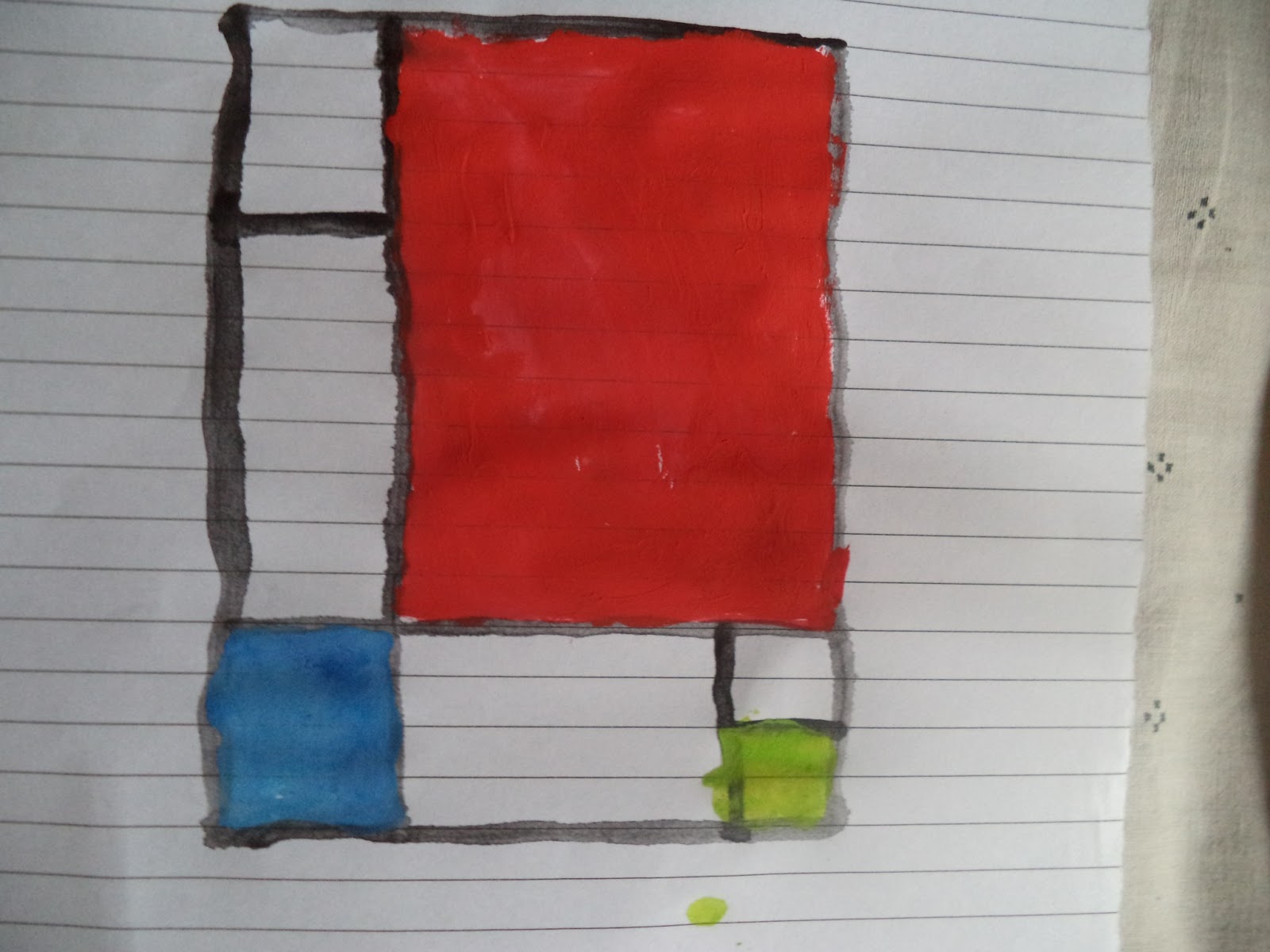
I sit with Vibhat now and then and do some painting. Once we copied a couple of paintings of Mondrian, the Dutch painter. I like Mondrian paintings and it occurred to me that the simplicity of the figures lend themselves well to painting by children. At the same time, there is power in the paintings, that is why he was respected. Mondrian paintings have stark simplicity and the colours stand out dramatically. After we finished our paintings (him the top one, me the bottom one) this impression of the strength of the paintings was reinforced for me. So perhaps copying Mondrian would be good for introducing children to painting ? The paintings are simple to do and if we as adults find his paintings get to the essence of colour, its quite likely they will have the same effect on children.

Interestingly, Mondrian designs have been also used in dresses and in shoes (see below).
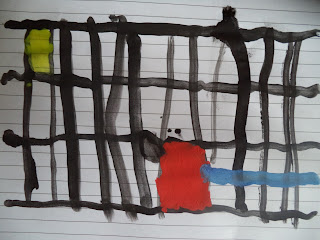


Here is the original of the second painting above:


Much on Modrian can (obviously) be found on the web: The Wikipedia entry on him would be a good starting point, as always. And  this google search link will give a quick look at a lot of his paintings.

A Mondrian dress, by Yves St Laurent. (Image used, without permission, from metmuseum.org )


I have been getting interested in painting, while sitting with Vibhat. Here is a tree I did, copied from a painting on the web:


Wednesday, April 17, 2013

Thinking about the Indian Railways


I find the Indian Railways endless fascinating at different levels and in different ways. This post is about policy and strategic direction.

Here are some recent media mentions in the Hindu:

Free Wi-Fi on trains http://www.thehindu.com/opinion/blogs/blog-hypertext/article4472521.ece
Comparisons to other train systems, especially China and the 'need for speed'
http://www.thehindu.com/opinion/open-page/why-are-we-on-slow-track/article4491959.ece 
A good piece by a senior railway man
http://www.thehindu.com/opinion/lead/saving-the-railways-for-the-aam-aadmi/article4415597.ece


Here are a couple of examples of an alternate direction that seems to me more sensible that some of the ideas above:
- In Switzerland and Germany the rail systems are trying to get to a state where there is hourly connectivity from every point to every other point. Ie, I can be at any station, and expect that in the next 1 hour there will be a train and appropriate connections that will take me to any other station in the system
- The Shivneri Volvo system between Pune and Mumbai. In this system there are buses leaving at a very high frequency, like one every 10 minutes or so. You can land up at the bus station without a ticket, and unless you are unlucky, catch a bus leaving in the next half hour at the max.


The following factors are important in my opinion:
- The Railways will continue to be a volume game in the times to come. Ie, given how the Railways are critical for the middle and lower classes, there will be huge pressure of numbers on the railways up to the next couple of decades atleast. How well the railways cope with this pressure is the main measure of its success
- The railways are a climate-friendly transportation option so we should be expanding and investing in them for the future

Here's my thinking:
Lets stop worrying about high speed trains. Lets not go down the path of proliferation of train types - passenger, express, superfast, shatabdi, jan shatabi, garib rath, duronto, double-decker and more. Lets instead plan towards a consistent system where trains are similar, reasonably fast, and there are a high number of connections between points in the systems at regular, predictable intervals. Between Chennai and Bangalore for example we now have Lalbagh, Brindavan, two Shatabdis, two express trains and a new double decker (besides other trains that travel this route as part of a longer journey). Would it be simpler to revamp this with say 10 trains, 5 during the day, 5 night, leaving at regular intervals and with similar facilities and travel times. Would this make safety management simpler, which will be crucial as the network gets more and more crowded ? As traffic keeps inexorably increasing, the number of trains would increase in proportion and in an obvious way, while keeping the template the same.
Can we go down this direction at a national scale too. Keep the focus on volume, cleanliness, consistency and safety.
Can we reduce the glaring disparity between compartment classes somewhat ?

There are many problems with the above but if the basic model is sound then these could be solved. A couple of issues below:
- How to serve the gazillion tiny stations all over the country if we are doing away the distinction between passenger and express trains ?
- Some of the romance and fun of rail travel would be lost, in doing away with things like train names, and making things similar and consistent. I say that we can find other ways to keep the fun alive. Not being able to travel because there are not enough seats is no fun anyway.

Friday, March 29, 2013

Late night wisdom

Militant right-to-life activists don't want to confront that their beliefs don't sit well with their actions eg. eating chicken. That's because the behavior change involved with giving up chicken is too difficult. Better than to accept your own imperfection and strive to be a decent person than make it your life's work to violently eradicate an injustice. 

Wednesday, January 09, 2013

Saturday, May 05, 2012

An experience with doctors


I have a problem called folliculitis over the past year and a half which results in random and unexpected skin infections. Although the problem is not per se very serious, it can get pretty painful, socially awkward and cause disruption to productivity. The infections occur randomly with no specific cause. Trying to get this problem properly treated has been an interesting and not fun experience. I saw a bunch of doctors over time with no resolution to the problem. Finally I had the luck to bump into a great doctor who solved the problem for me with minimal trouble (more on that below). But what was disturbing about the experience with the other doctors was how different their prescriptions were, from what actually worked finally.
I overall saw 7 doctors about this problem. The range of options suggested included:
- undergoing (expensive) antibiotic courses
- doing (expensive) blood tests to find out what was the exact nature of the infection
- using an antibiotic soap and a nose ointment
- yoga and meditation. This from a Manipal Hospital doctor who looked ill at ease and out of depth and suggested that there was nothing much that could be done.
- getting hair replacement therapy. Really. One joker of a guy was disappointed to see that I had come to him with a skin infection instead of a baldness problem. After cursorily looking at the boil and prescribing antibiotics and a blood test, he tried to sell me a hair replacement treatment course. This guy was also morbidly obese and badly dressed, hardly the kind of personality to inspire confidence.

With no progress (and taking the Manipal docs advice seriously) I let the problem lie for a while. Then, I again tried to address it during my sabbatical when I had some time. Having no way to identify a good doc, I decided to pick a few doctors and try a consultation with all of them. I got really lucky with the first doctor (Dr. Divya Appachan) but decided to go ahead and see one more, just to follow through on the original plan. Doing that provided a nice comparison, since I visited them both on the same day with exactly the same symptoms.
The two doctors were a study in contrasts:
1.) Dr. Divya Appachan spent a considerable amount of time, looking closely at each boil and asking me questions about the nature and frequency of the infections. The other doc, (call him Doctor A) took a look at one sets of boils from a safe distance and that was it. Both diagnosed it as folliculitis.
2.) Dr. Appachan explained a set of measures that I could take to manage the infections. An ointment (T-Bact) should be applied immediately as soon as a new boil shows up. The boil is likely to go away right away if that is done. In case it doesn't, it would tend to grow and a small amount of pus would form. She showed me how to poke it painlessly with a sterile needle to discharge the pus. Following that, using the same ointment should do the trick. If these measures didn't work, she said we would go to the next step of an antibiotic course. But it would be better to avoid the antibiotics. I had a bunch of questions that she listened to and patiently explained the answers to. She also suggested that the (expensive) antibiotic soap that I had been using based on earlier doc recommendations should not be needed. She did not ask me to visit again, unless I had a problem.
The treatment has worked very well so far and I'm feeling very good about it. I haven't had to visit her again.

After the quick examination above, Dr A, on the other hand, prescribed two sets of powerful antibiotic treatments simultaneously. We'll hit it from both sides he said with the enthusiasm of a child setting up a toy battle. Never mind that the battlefield in this case was my body, and the ammunition, my wallet. He asked me to come back afer a week of the treatment.

3.)Both charged the same

I guess I don't need to add further comments on the above. Its a sorry state of affairs. I think the approach of seeing several doctors before picking one is not a bad one.

Tuesday, April 17, 2012

New videos

Two water and sanitation movies that I edited and uploaded recently:


Monday, April 02, 2012

"Better" by Atul Gawande


I just read an excellent book "Better" by Atul Gawande. Gawande is a surgeon in the US and writes frequently and well (books, articles etc.). "Better" is a great general read, but here are two ideas from there that are simple, elegant and should be done in India too:

1.) Vaccine fund: It is well-known scientifically that most vaccines have side-effects (in the worst case, very severe) that affect a very small fraction of the people (children) who take them. Presumably, public health professionals have evaluated these incidences and concluded that the greater good is worth the unfortunate few cases. But society has some kind of obligation to those unfortunate few. In the US this is institutionalized through a small surcharge on the cost of the vaccine, the proceeds of which go to a fund for those who are adversely affected by the vaccine. Surely we should do something of this sort in India too ?

2.) A fund to cover the cost of people who suffer due to errors/negligence/bad luck etc in medical care. This is not there in the US but is there in New Zealand. It comes up in the author's discussion of the medical malpractice industry in the US. If you suffer due to error or negligence of a health care provider in the US, the only recourse you have is through the courts. This is a far from perfect system as it works currently in the US. Only a tiny fraction of people who feel they have suffered from errors or negligence go to court due to the expense and the risks. When someone is awarded damages, they tend to be very large amounts. So the system delivers justice only to a very small fraction of people who have a very strong case of severe harm caused. On the medical professional's side, this system leads to very large amounts they have to pay in premiums for their malpractice insurance. The author argues that it would be much better to have a system where there is a common fund for people who suffer due to a slipup in medical care. The system does not worry so much about finding out who is at fault, rather it tries to remedy the damage done to the patient. Through this system a lot more people benefit, though there is a cap on the amount you can get otherwise the overall cost of the system would be impossibly high.
Again something that we need in India too ?

Gawande ends with a short list of 'recommendations' for medical students for them to be better doctors. One is particular I liked:

Count Something. Regardless of what one ultimately does in medicine - or outside medicine for that matter - one should be a scientist in this world. In the simplest terms, this means one should count something. The laboratory researcher may count the number of tumor cells in a petri dish that have a particular gene defect. Likewise the clinician might count the number of patients who develop a particular complication from treatment - or just how many are actually seen on time and how many are made to wait. It doesn't really matter what you count. You don't need a research grant. The only requirement is that what you count should be interesting to you.

More on the book and Gawande at gawande.com. You can borrow this book from easylib.com in Bangalore, the library service I use.

Thursday, March 29, 2012

On Gold

For some time now I've been puzzling over ... gold. I have an instinctive and visceral dislike for gold jewellery (and the buying of it!). I was trying to get at the root of it and perhaps I have.

The 'buy gold' logic is very compelling. Your wife wants it. (Well atleast my wife does and so do most of our female relatives and a lot of friends, though I'm sure nowadays a lot of women have managed to stay out of it). As a guy it makes sense because it is an investment and not a consumption expense so you're keeping your wife very happy essentially without spending any money! What a win-win !

So why do I hate it so much.

I think its because all the gold comes out at events like weddings, and women overload themselves massively with it. Gold as ornamentation works upto a certain amount of the stuff ; too much and it takes away from beauty instead of complementing or enhancing it. You are no longer a person, you are a hanger to hang all this gold off of.

The primary function of wearing lots of gold jewellery is to communicate the message: 'I have lots of money'. And that's disgusting.

PS: From Sajini, here's a CBS TV segment on the same topic.

http://youtu.be/sUr2E4dfs0Y

Sunday, November 27, 2011

Kilikili


I had a very nice 'Eureka' moment recently. On Rainbow FM (the AIR FM channel?) there was a programme "Folks with Different Strokes" (?). It featured a lady whose child had a mental disability and how she and her husband coped with it and went on to found an NGO "KiliKili", to create playspaces for children with disabilities. The lady was simply fantastic. One could see that she had beautifully come to terms with the difficulty of having and raising a differently-abled child, and there was great spirit and strength and no bitterness whatsoever visible. The host was fantastic too, asking good questions, interjecting when needed, generally sensitive and soft-spoken. From the way the interview went, she seemed to have done a horrific amount of preparation. How wasteful and old-fashioned! To actually do research before going on air. Kudos to this hostess, whose name wasn't mentioned on air. The interviewee was Kavitha Krishnamoorthy and the organisation she co-founded can be found at www.kilikili.org .

The icing on the cake for me was a small personal connection through Chitra Vishwanath of Biome Solutions (www.biome-solutions.com), the redoubtable environmental architect who was mentioned on air as having worked with this group to design playgrounds that are usable by all kinds of children.

So - this was one of the best programmes I've heard on air (both TV and radio) in India. Truly an example of what TV and radio could be at its best. Not that these media should only show inspirational true stories, but the current fare on offer is mostly uninspired without depth or substance. The programme compared well with the best I've heard on radio in the US.

"Folks with different strokes" airs every alternate Saturday between 6 and 8 pm.

========
I was delighted to see the following comment on this post from Rashmi Shetty :

Hi VK,
I was directed to your blog by a friend. You sure write well.I am Rashmi Shetty, the hostess of Folks with different strokes. Thank you for the feedback:-)
From the second saturday of May this year, Folks with different strokes has changed to INSPIRE .It is on air from 7p.m- 8p.m every alternate saturday. 
On reading your feedback thought I'd give you the update.
Thanks again.

Sunday, October 16, 2011

On the cost of clothes


Sometime back I started thinking about this idea below of evaluating how one spends money on clothes. I mentioned it in one of the earlier posts on the blog, but then I continued to think about it and found it more and more interesting, so here's the idea now fleshed out more. The intention to keep detailing it out until I can get something to publish in a peer-reviewed journal :-) ( the Journal of Consumer Economics ?)

==

You could evaluate your clothes by dividing the cost of an item by the number of times you wore it. You'd look for a low number to come out of the ratio as that would indicate that it didn't cost you much and you used it a lot, therefore good value. We could call this number the cost per use (CPU). It seems an interesting way to evaluate the worth or the value you get out of it.

I've continued to think about this and find it very interesting. Firstly, you can think about how much money you're wearing everyday. This is the total cost per use of all the things you're wearing (lets restrict it to just clothes, including undergarments and footwear but not jewellery and accessories). I was surprised by the number that I estimated, in my case: greater than 50/-. I wouldn't have thought I was spending that much on clothes every day ! Take a 1500/- Rs pair of jeans which I bought recently ; I'd have to wear it a 100 times for the cost per use to come down to 15/- . I think I'll probably not use it so many times, perhaps 75 times is more like it. So cost per use is Rs 20/-. For other trousers I expect I'll use them even less than 75 times so if they cost the same, the CPU is even higher. A similar calculation for shirts, which could cost 500/- to 700/- for the kind of shirts I wear to work but which I would wear less number of times than trousers before discarding or giving away, perhaps 30-50 times (so CPU average around 15/-). Then calculate the cost for undergarments , shoes/socks, belt . And an unexpected extra, the cost of washing and ironing. Ironing now costs 4/- a garment for me, so that's close to 10/- for ironing itself ! So as I said, adding it all up, a total of Rs 50/- per day.

Its an interesting calculation to do.

The one thing that cost surpringly less for me was footwear. The current pair I use is from Bata, a fairly nice piece that is very reasonably priced at around 450/-. And since I use it everyday pretty much, I've probably used it more than 100 times already, so the cost per wear is down to 4.50 /- already . Very low compared to shirts and pants ! And its in pretty good shape still and could easily go for another 6 months, so the cost per wear is coming down even further. It seems I could cut down the amount I pay on clothes and splurge a little more on footwear, to reach a more optimal point.


For fancy clothes that you wear for special occasions, the cost / use would be much higher than for daily wear clothes. This is because these would be pretty expensive clothes, that we would wear it very few times, so double the effect. For eg. all the suits I've bought, I've used only a couple of times, and then they've gotten too tight for me :-( .

You can start doing this for the other things you buy and use. For example my cellphone cost is horrendous ; each time I've bought a high end phone (both Nokias), I've enjoyed using them a lot but they've lasted relatively short. The first one for eg. cost about 13000 and lasted for about 18 months, so that's close to 750/- per month ! No more expensive phones for me!