Showing posts with label idea. Show all posts

Friday, September 30, 2016

Teaching Graphs


I've been intensively tracking visitors to this blog using the tools Google provides. Vibhat kept seeing the usage graphs on the screen and asked me what was that funny picture. So I sat down with him to try to explain graphs. He got the basic funda in just a few minutes and was saying "Ok when there's a lot of visitors that's when there's a peak in the picture and when there's very few its low".  I was very surprised. I was expecting a painful process of him having to understand x-axis , y-axis, lengths along axes. But without talking much about axes, I was able to communicate the idea. 
In contrast, I remember how I learnt graphs - getting introduced to graph paper, then counting distance along axes, then plotting abstract points like (3,4) and so on. It must have happened over atleast a month or so. In retrospect it seems a painfully abstract and unnecessary process. 

So, is graphing much easier to understand when you do it with a 
real-world example ? 
----
Separately, I've been getting about 20 visitors per day to the blog, but there are two curious spikes in 2014 and 2016 as you can see in the graph which I am not able to explain. However, there seem to be a lot of spammers and other junk visits, so the actual numbers could be even lower :-( 

Saturday, September 17, 2016

My article on Solapur


I wrote an article for the Six Degrees  News website. Six Degrees is an international development news website that focusses on grassroots reports. My article was about a government programme called Jal Yukt Shivar in Maharashtra. Here it is:  

I’m excited about having done this. I’ve not been officially ‘published’ for a while now, if at all, though I guess there were opportunities at Arghyam that I’ve passed up due to other work. Six Degrees is founded by a friend, Binayak Das, so it didn’t require pitching from my side, and I didn’t get paid for it. 
Whatever I do (if I do anything at all!) in the next phase of my life, I hope writing will be a part of it. This blog has been a source of great fulfilment but time to grow beyond it. And it would be good to be able to generate some income from writing. 

I learnt some practicalities about journalism on the trip. One was the difficulty of really evaluating the success of a programme or initiative from a visit. Though I have a background in the water sector, I’m a generalist and not technically trained, so it was hard to really gauge. And for a large scale programme like this, unless you visit lots of locations, you can’t conclude anything with any degree of confidence. Your ideas about this will be appreciated. 

Anyway, on the visit to Solapur in Maharashtra, based on which I wrote the article, I had the opportunity to meet the current District Collector. It happened quite easily, after a couple of phone calls, which was quite surprising. At Arghyam, it was really painful getting meetings with IAS officers. He was a very cordial and a nice person. However the really interesting bit was about the previous Collector, Tukaram Munde. He really seems to be a larger-than-life person who managed to achieve spectacular results. I have some sense of administration from work at Arghyam, and this chap in my opinion is off the charts. The District Collector (or Commissioner as he is called in some districts) has a really difficult job. There’s just too much stuff, too many subjects to work on. There are around 30 government departments/programmes that he is the head for. The DC of Sholapur told me there are literally hundreds of committees that he  chairs. Then there is the lack of good quality and quantity of HR to work with, including corrupt people. And unlike the private sector, you can't fire people easily. There are many restrictions and rules to getting work done, much less flexibility than in the private sector. There is the political system to be managed, which could be quite formidable. And in the first place, many of the programmes are ill-designed and ‘dead-on-arrival’. So I’d say, as far as serious impact is concerned, the DC is also for the most part, ‘dead-on-arrival’. However, Mr. Mundhe somehow managed to crack the system and actually get it to deliver. For the life of me, I cannot visualise how he did it. He is now head of Navi Mumbai district and making waves there too. A man to watch (and you can watch some of his exploits by searching on the web). 

Back to the trip again. There is a ‘power’ element in the field trip portion of visits like these , the government staff down the line from the DC are very deferential. At the same time I also got the sense that they thought I did not understand the stuff, and were patronising. I also find it tiring to meet a large number of people in a short span - my comfort level certainly is in meeting fewer people and developing stronger connections with them. 

I wonder where Jalyukt Shivar is going. There seem to be many issues with the scheme, much more so in other districts. But it also seems to have huge potential from the Solapur experience. This programme seems to have the tantalising potential to be the ‘Holy Grail’ for water security in drought-affected districts. But many a slip between the cup and the lip. At the same time some other large scale success stories are emerging from other districts like Dewas in Madhya Pradesh. Is there a trend here ? In the past, it was always about NGO models and touting them, but there were very few examples of successes at scale. Are we entering a tipping point where we get more and and more successes at scale. I fervently hope so. 


An interesting side point is that Solapur district has 2 products with the GI (Geographical Indication) tag, Maldandi jowar and Sangoli pomogranate. Here is a full list of GI tagged products in India: https://en.wikipedia.org/wiki/List_of_Geographical_Indications_in_India 
It seems this idea is taking off in India.


Some more photos from the trip below:


Check dams storing water


Compartment bunds under construction


Dry open wells that are now recharged with water


A farm pond

Local farmer


Wednesday, September 07, 2016

Elements of a Life Philosophy - 2 : The nature of mind and thinking


Second in a series of posts trying to write down my philosophy of life. First one here: http://despoki.blogspot.in/2016/08/lifes-experiences-leaves-their-mark-on.html 

Most Indian spiritual thinkers in one way or the other talk of this notion of being without thought. At the extreme you will see writing that says that enlightenment is the state of being without thought. 

Meditation, as I’ve understood and practised it, is a process of being able to separate myself from identifying with my thoughts and instead being able to observe them. And sometimes the mind quietens down enough so that it is more or less blank. When I have reached that state in meditation, I always feel good about it. Often - unexpected thoughts pop out during this period of thoughtlessness, thoughts that would not have otherwise come to me. Thoughtlessness seems to give the space for stuff that’s buried in some way, to surface. 
Being able to observe thoughts implies that there is an ‘I’ different from the thoughts. This feels like it is a huge deal, but I’ve not been able to make much progress in taking this understanding further. 

We always identify ourselves with what we think. But our mind is an unreliable instrument. When extreme events happen they leave their mark on the mind, which stops behaving rationally in that area. So really we cannot depend on the mind to guide us correctly in most important decisions. As an example - to have a difficult conversation with a colleague at work might be objectively very important to clear up some misunderstandings or to work more effectively. But the mind protests mightily and comes up with all sorts of reasons not to have that conversation. So how to know when to trust what the mind says and when not to? If you accept that the mind is not always to be trusted, it opens a whole can of worms. Landmark’s way out of this impasse is the idea of the spoken word or declaration. Once we declare that we are something (‘happy’, ‘smart’) or going to do something (‘2 crores in turnover’) then that’s the guiding light. Our actions have to be in consonance with the declaration, not the mood or the thought of the moment. 

J Krishnamurti talked about thought arising when it is needed, for example to solve an intellectual problem, and then ceasing. Whereas normally our brain is always thinking of some thing or other. This resonates well with a distinction that someone at Landmark once made between ‘thinking’ and ‘thoughting’. The process of thinking is an active one, when we call on the brain to apply itself to some issue or matter at hand. Like making a business strategy, or planning the day's work. ‘Thoughting’ is the default process where thoughts come of their own volition. This is passive thinking and usually unproductive. A lot of our internal dialogue of complaining about people and events, worrying about the future, feeling bad (or good) about the past falls into this category of ‘thoughting’. If we eliminate 'thoughting' that leaves a lot of time when we don't need to think, we are just doing or being


Notes:
Ramana Maharishi on thoughts: " All thoughts are inconsistent with realisation. The right thing to do is exclude thoughts of oneself and all other thoughts. Thought is one thing and realisation is quite another"


Sunday, September 04, 2016

Small small insights - sugar


Natural sugar (from fruit) is packaged so that there is not too high a concentration of sugar. You can't eat huge quantities of it - your stomach gets full. So there's a built-in limit. You also get some other nutrients for free. With refined sugar,  you can get a highly concentrated dose of sugar and nobody's checking.  No extra nutrients either. 

I've cut down on refined sugar a great deal. One of the noticeable effects over time is that your mood is more stable. You don't go through a cycle of sugar craving followed by eating something sweet and getting a sugar high. I never noticed that I was going through this cycle until I cut down on the sugar.

Stick to fruit sugar.


A previous post on food/cooking: http://despoki.blogspot.in/2009/01/some-thoughts.html 

Monday, August 29, 2016

Responsible tourism


When you travel, you have an opportunity to use your money in a way that supports the local people in their livelihoods. There are two theoretical concepts in this connection:

1)leakage: this is related to how much tourism money stays in the local economy and how much goes out. If the money goes to local people and they in turn use that to pay other local people, the money benefits the local economy more and more. This is good.
2.) who benefits locally. Ideally it would be nice if our money could support those lower on the economic ladder as much as possible 

As an example, I noticed that the comparatively small town of Aurangabad has some pretty fancy hotels. Of course this is because its the nearest base for the Ajantha and Ellora caves. So I can visualise that rich tourists would fly into Aurangabad, go to a fancy hotel, then take a rental car, go to Ajantha and Ellora and then back to the hotel and then back to the airport and out. If you analyse the money they spend, you can see that most of it leaks or doesn't stay in the local economy:

- flight : money mostly goes to aviation fuel, trained airline and airport personnel 
- vehicle : mostly towards fuel (a good that comes from outside) and the driver (money stays locally hopefully)
- hotel : high-end hotels usually use a lot of men and material from outside the local area, both in their construction and running. 


When you think about it, responsible tourism is pretty hard to do in India. We would like to stay in reasonably decent places, which are clean, hygienic and pleasant. Unfortunately, this isn't part of the culture in India generally it seems (see : http://despoki.blogspot.in/2016/08/a-new-kind-of-hotel.html     ) . In our food too,  given low food hygiene standards in India , we obviously would tend to try to go to as upscale a place as possible to be safe, and give the local mom-and-pop shops a miss. 

So it can be a challenge. But I think with a little thought and with crowdsourcing of ideas, we could come up with quite a lot of good ways to support the local economy as much as we can when travelling.  Here's some to start with:


1.) Homestay and hostels: These are quite interesting staying options until my "new kind of hotel" becomes a reality. The negatives of bad hotels don't seem to apply to a large extent to households in India. So the idea of homestays ( where you stay at someone's home, not a hotel) might work out quite well, though its still in its infancy now. Youth hostels tend to be decently maintained and run and are another option. So are hotels run by the tourism department, though the quality of these varies widely in practice. 

2.) Buying the local traditional arts and crafts: This is a no-brainer and something most of us love to do anyway. The more research we do before going on a trip, the better in this regard. For example, to find producers who give their workers a decent wage and to find genuine products rather than cheap ripoffs. 

3.) Hire a good tour guide please, when you go to a historical monument or area. This is an excellent way to contribute, while enhancing your own experience of the area

3.) Another idea, not for the faint-hearted, would be to give a fraction of the money you spend on your trip to an NGO or other deserving cause in the local area.  10% would be a nice starting point, and 50% would be pretty cool :-) 


In general, the longer you stay in the area and more you get to understand and appreciate the local people and culture, the better, it seems to me. Hurried in-and-out and weekend trips don't serve anyone very well, it seems to me 


I paid Rs350/- for this collection of nice geological specimens to a  random salesman on my recent trip to Aurangabad. Coral, quarts and agate he told me. I am quite happy about the purchase but I wonder how this thing works. How much time does it take to find these pieces, who does the search, whom does the money go to ?


Notes, References:

1. If you're going to Wayanad, staying at the Wayanad County resort directly contribute to the well-being of tribal workers at the associated plantation. Read the happy story:  
http://www.thebetterindia.com/66124/ias-officer-prasanth-nair-priyadarshini-tea-estate-tourism-hunger-malnutrition-tribal-people-wayanad/


Friday, August 12, 2016

A new kind of hotel


From travels in small town India I have had enough experience of hotels in the Rs 2000/- and below range. With a few exceptions the experience has been uniformly uninspiring. 
Things that make the travel experience less than fun include:

  • the hotels are grimy and dirty 
  • rooms have cheap plastic furniture that ages very fast and looks shabby 
  • cobwebs
  • walls always have stains, discolourations or yikes, cracks 
  • power cuts 
  • kitschy out-of-place decor if at all. A hotel I went to recently had a life-sized wooden sculpture of the famous Marilyn Monroe image.  
  • yucky toilets - of course the thing that most spoils a hotel experience. Smelly, leaky taps, non-functional plumbing,   
  • highly dubious bed linen and blankets 
  • Restaurants if-present , have the deadening standard pan-india menu , you find in countless hotels countrywide. I call it the ‘panneer butter masala’ menu 


There is a deep and pervasive lack of interest in maintenance (and it runs much deeper in India than just hotels). I wonder why this is. Is it so expensive to keep a room clean and have everything work the way it should be ? 

The other ‘design pattern’ is the choice of building and furnishing material that ages rapidly or starts looking bad quickly and easily. Flooring material, Nilkamal chairs, wall paint 


I therefore propose a new kind of hotel. The design philosophy is: 

austere, spartan, impeccable, fanatic about cleanliness, local culture and aesthetics 

Have less stuff or less facilities, but keep whatever you have looking good and maintain it 
Have a breakthrough in bathroom quality. 
Figure out how to keep the walls clean - maybe use whitewash which is cheaper and repaint more frequently  
Start working with a whole new set of materials that do the job  without degrading in appearance and quality rapidly over time  
Figure out a new menu tapping into local expertise and local traditions 

I read the logic of Tata’s Ginger chain of hotels somewhere and they seem to be on these lines. And pilgrim spots like Tirumala tend to work on these lines of austere and functional. We can build on these and other experiences  


Sunday, September 01, 2013

That we are all imperfect or flawed is obvious and a truism. One deeper understanding of it is: there are times when we are helplessly dependant on others, and there will be times when the vice versa is true. This is often true with a significant other. We should let this be, instead of trying to be tough and independent and not allowing oneself to be 'at the mercy' of others. Being dependant or vulnerable is a passing thing, and you can be sure that the tables will be turned at some point.

Sunday, October 16, 2011

On the cost of clothes


Sometime back I started thinking about this idea below of evaluating how one spends money on clothes. I mentioned it in one of the earlier posts on the blog, but then I continued to think about it and found it more and more interesting, so here's the idea now fleshed out more. The intention to keep detailing it out until I can get something to publish in a peer-reviewed journal :-) ( the Journal of Consumer Economics ?)

==

You could evaluate your clothes by dividing the cost of an item by the number of times you wore it. You'd look for a low number to come out of the ratio as that would indicate that it didn't cost you much and you used it a lot, therefore good value. We could call this number the cost per use (CPU). It seems an interesting way to evaluate the worth or the value you get out of it.

I've continued to think about this and find it very interesting. Firstly, you can think about how much money you're wearing everyday. This is the total cost per use of all the things you're wearing (lets restrict it to just clothes, including undergarments and footwear but not jewellery and accessories). I was surprised by the number that I estimated, in my case: greater than 50/-. I wouldn't have thought I was spending that much on clothes every day ! Take a 1500/- Rs pair of jeans which I bought recently ; I'd have to wear it a 100 times for the cost per use to come down to 15/- . I think I'll probably not use it so many times, perhaps 75 times is more like it. So cost per use is Rs 20/-. For other trousers I expect I'll use them even less than 75 times so if they cost the same, the CPU is even higher. A similar calculation for shirts, which could cost 500/- to 700/- for the kind of shirts I wear to work but which I would wear less number of times than trousers before discarding or giving away, perhaps 30-50 times (so CPU average around 15/-). Then calculate the cost for undergarments , shoes/socks, belt . And an unexpected extra, the cost of washing and ironing. Ironing now costs 4/- a garment for me, so that's close to 10/- for ironing itself ! So as I said, adding it all up, a total of Rs 50/- per day.

Its an interesting calculation to do.

The one thing that cost surpringly less for me was footwear. The current pair I use is from Bata, a fairly nice piece that is very reasonably priced at around 450/-. And since I use it everyday pretty much, I've probably used it more than 100 times already, so the cost per wear is down to 4.50 /- already . Very low compared to shirts and pants ! And its in pretty good shape still and could easily go for another 6 months, so the cost per wear is coming down even further. It seems I could cut down the amount I pay on clothes and splurge a little more on footwear, to reach a more optimal point.


For fancy clothes that you wear for special occasions, the cost / use would be much higher than for daily wear clothes. This is because these would be pretty expensive clothes, that we would wear it very few times, so double the effect. For eg. all the suits I've bought, I've used only a couple of times, and then they've gotten too tight for me :-( .

You can start doing this for the other things you buy and use. For example my cellphone cost is horrendous ; each time I've bought a high end phone (both Nokias), I've enjoyed using them a lot but they've lasted relatively short. The first one for eg. cost about 13000 and lasted for about 18 months, so that's close to 750/- per month ! No more expensive phones for me!

Saturday, August 28, 2010

On education


What is the purpose of education? There are many answers, and three common ones are below:

-'to succeed in the fast-paced, competitive modern world' (an answer that I find particularly moronic)
-'to equip the child with the knowledge and skills to find work to support themselves'
-'to discover one's talents'

Are you satisfied by any of the above answers ? I'm not, in fact I'm tremendous dissatisfied with the education system (of personal interest now that I am a father). Human minds are complex. We experience emotions - joy, anger, jealousy, contempt,love. We complain about other peoples' actions and justify ours. But do we have to take all these as given, these things are how we are, or is it possible to 'step outside' of oneself, and be able to observe how our minds work, why we react the way we react, what are the hidden motivations or insecurities. As the child is growing up and its character being formed - is it possible to have serious conversations about the rather imperfect nature of the world we live in, with how we rationalize the way we (in India atleast) make our peace with the enormous poverty and suffering outside our doorsteps in order to carry on our lives. Is it possible to teach children to be decent, happy individuals ?

Can we teach children to be alive to the mystery of life ? Here we are, blobs of protoplasm with odd projections that enable us to locomote manipulate, on a large orb circling a ball of fire, in the middle of a vastness we cannot comprehend. We are one in billions today and have been preceded by billions and will be followed by billions. So how do we come to terms with all this ? Normally all this is pushed to the back of the mind so we can get on with the day to day business of life, survival, freedom from pain and discomfort, pleasure, achievement and all that ? Can we teach our children to do a better of job of this than us? And what of the infinite complexity and variety of life on earth. Can we teach our children to be open to that?

Schools have to teach maths, physics and geography and so on. But if we as parents and teachers don't weave in the above we have lost the spirit of education. And this is the state of affairs across the board. I am sure the most expensive and fancy schools don't do that much better of a job than the middle-class schools in this, because the management and the parents are as much invested in the status quo of the world today, in fact even more, so that they are uninterested in questioning it.

Post Script:
We were casually talking about something related to schools at work once, and during that I spontaneously burst out: "I have zero faith in the educational system!". I was myself suprised by my vehemence as it was not premeditated, and to some extent I didn't even know that I felt this way. Some subsequent reflection resulted in the picture I lay out above. I find it ironic that having done excellently by conventional standards in most of my education, I now am completely disdaining it. But all the reflection, discovery and learning that happened for me, mostly slowly and haltingly, completely parallel to or outside the educational system, is central to what I am today. I see that as a tremendous failure of the education system.

I don't think many people feel so negatively about schools as I do. This leads to a nicely ironic dilemma for me: at least others are comfortable with the current system, and they are true to themselves if they don't fight against it. If I don't, I am being a complete fake. And the job I am talking about above is so gigantic and so seems so much beyond my capabilities.

The above thoughts are tremendously influenced by J. Krishnamurti's writings. But I have internalized them so completely and find them so obvious now, that I am not parroting what someone else is saying.


"It is our earth, not yours or mine or his. We are meant to live on it, helping each other, not destroying each other. This is not some romantic nonsense, but the actual fact"

Monday, June 28, 2010

Rework The World


I went to the Rework the World conference, www.reworktheworld.org in early June, representing Arghyam. The conference was in Leksand, a lakeside resort a few hours north of Stockholm. The conference was a very good experience. The next and last edition of the conference , which is one of a series is going to be held in Alexandria , Egypt in 2012 and I heartily recommend that to any young person, though needless to say, it would be quite expensive.

As luck would have it, my passport was quite close to expiring and I needed to get it renewed. I had a difficult time getting the renewal done ; worth its own blog post!

I flew out of Delhi and back to Delhi which make the overall trip more strenuous.

The event was on youth and social entrepreneurship. It was co-organised by two interesting groups the Yes Foundation (one of whose key people is an Indian American, Poonam Ahluwalia), and the Tallberg Foundation, a wellknown think-tank in Sweden. The trip expenses were sponsored by the organisers which was really nice of them, though I think they were hoping I would play a more active role than I did.

From Stockholm Airport, I drove down to the conference location by car with Thomas Bjelkeman-Petersson of Akvo.org, who's visited us in India a few times. It was a great drive through open sparsely populated countryside. A very welcome break from the crush and the dirt of Bangalore and India which gets to me.

There was a huge amount of infectious energy in the gathering ; so many people, especially youth (1500+), all trying to make the world a better place, all over the world.

Lots of particulars that bear a passing comment but maybe in a later post.

Some videos below:
1.) The Max hamburger chain in Sweden now tracks the carbon footprint of each kind of burger and lets you know !


2.) There was a lot of great music at the event:

Tuesday, January 26, 2010

This year's Padma awards


Today's announcement of the Padma awards gives some scope for criticism:

Venkatraman Ramakrishnan, A.R. Rehman, Resul Pookutty: We must be the only country that gives national awards to our people after they get international awards. I guess we give awards to people for having gotten international recognition, not for their work. A thoroughgoing shame. It would be interesting to dig deeper and see how often we are able notice and recognise peoples achievements before they reach international renown. I don't think we do a good job.

Prathap C. Reddy (Apollo Hospitals), C.P.Krishnan Nair (Leela Hotel Group chairman), DLF Chairman Kushal Pal Singh : I find it disturbing to see awards going to successful businesspersons whose where the work done or the business concerned doesn't have any otherwise important or socially relevant features. In the case of Apollo Hospitals and other corporate hospitals there is a definite ambiguity about them - there is a common perception of money-driven practice of medicine. Why award Leela Hotels for running a business of luxury hotels which 99% of the country will never stay at? And how many think DLF got to where it is without underhand dealings ? On the contrary, I find the award to Venu Srinivasan of TVS and current head of CII appropriate. M.S.Banga of Unilever is a bit on the borderline.

Looking through the entire list of awardess, overall, for a poor country like our, perhaps the awards should be more focussed on people who are contributing a bit more directly to national development.


Comments ?

Sunday, May 17, 2009

Myers-Briggs Type Indicator

This weekend I re-looked at my Myers-Briggs Type Indicator.
 The Myers-Briggs Type Indicator (MBTI) is a tool to help you understand your personality type.  At a Juniper manager training we went through a MBTI type identification exercise and I found it pretty useful. 

  Very crudely MBTI consists of 4 types of 'being'

1.)   Where people prefer to focus their attention and get energy:
   Extroversion (symbol E, from external objects and people) Introversion (symbol I, from their own mental space)

2.)   The way they prefer to take in information
   Sensing (symbol S) , Intuition (symbol N)  
 
3.)  The way they prefer to make decisions
   Thinking (T)  or Feeling (F)

4.)   How they prefer to orient themselves to the external world 
   Judging (J) or Perceiving (P) 

There are more detailed descriptions of what each of the above mean.

There are a series of questions you answer and they help to identify your type on each of the indicators and then arrive at a composite type (for eg Intuition - Sensing - Thinking - Perceiving, ISTP) of which they are 16. The model has an extensive description of the broad traits of each type. At the training there was also a discussion on how these type behaviours and how they manifest in the workplace and how people of different types work together well (or not). I think this exercise is of particular value to people to remind them that their worldview is not universal, and particularly that there is an entire personality model built around various ways of being and that ones own way of being is just one type, and is no more valid or correct than others. 
The value of this personality typing exercise I personally found included:

 -- to revisit the fact that I feel inadequate about several things ; this exercise suggests that you feel comfortable in your natural strengths and build on them.
 -- placing your own abilities and weaknesses in a broader framework like this means that you can then see the really irritating things that others do within the same framework and see that  the other person is not objectively wrong in behaving a certain way. 

  There's probably lots of material on the web about MBTI, and I would encourage you to find out more. But the real value would come from doing it with an expert who would put you through the questions to find out your type and the discussion that follows. 

   Personally I had a fair bit of trouble in fully identifying my type. I identified it as INFP (Introversion, Intuition, Feeling, Perceiving). I had a lot of ambiguity between Feeling and Thinking. I think it comes out of preparing intensively for the IIT entrance and then doing engineering, where the whole atmosphere is logical and fact-based and feeling plays no role. Also the model points out that there are different degrees to which people are able to clearly identify their type and less-clarified type may be due to lack of freedom to explore or suppression in childhood etc. I think a lot of Indians would exhibit this kind of thing, since  a lot of Indians (especially poorer people) would grow up in a situation that precludes freedom and exploration and development.

Some links:
http://en.wikipedia.org/wiki/Myers-Briggs_Type_Indicator - MBTI on Wikipedia
http://www.myersbriggs.org/ Myers-Briggs Foundation
http://www.personalitypathways.com/type_inventory.html Some more introductory material

Sunday, April 26, 2009

From here and there

1.) I started tagging my older posts (scroll down and look for the "Labels" section on the right hand side of this page). Still a huge task if I want to tag all the posts from day 1. However, I'm quite happy to see on going through some of the older posts that I actually like them and find it worth looking at them again. Too often, when I go back to look at something I wrote, I feel nauseated, so this is a good surprise. If/when this exercise is completed it might show some interesting patterns about the kind of things that interest me and that I write about

2.) I went to the other end of town for a meeting today, and bought organic mangoes from the lady of the house who runs a small shop out of the house selling organics. This seems to be a cool idea. Organic food seems particularly amenable to having lots of small neighbourhood shops selling them. I want to set up one

3.) And a note on one of the bees in my bonnet (or should I say closet): clothes. Think about this: you could evaluate your clothes by dividing the cost of the item by the number of times you wore it. You'd look for a low number to come out of the ratio as that would indicate that it didn't cost you much and you used it a lot. It seems an interesting way to evaluate the worth or the value you get out of it. Couple of points: especially for women, I think the value would be concentrated on a low end and a high end, with a dip in the middle, rather than evenly distributed. This is because there would be some pretty expensive thing, and then precisely because it was so expensive, we would wear it very few times, so that its worth by the above calculation would be very high. For eg. all the suits I've bought I've used only a couple of times, and then they've gotten too tight for me :-(. And then you'd have stuff like jeans, whose worth would be very low.

4.) We were at the doctor's clinic over the weekend, when a couple rushed in. Shockingly the lower portion of the woman's sari was completely stained in blood and she was in great pain and moaning. The doctor was quite upset -- this was her consultation clinic with no facilities for taking care of patients and the lady had been sent there mistakenly by a hospital. They were sent off to another nearby nursing home.
It was painful to watch. Since the doctor was a ob/gyn, it was probably a pregnancy or an abortion related problem. The couple was from a lower economic background. A sad reminder of how the other half lives, which we are insulated from, most of the time.

Saturday, April 18, 2009

Tickettttt !!!!

BMTC Bus, Ashok Leyland

I feel bad for BMTC bus drivers (and the traffic policemen, but that's a post for another day). They have to deal with so much crap on the road; scooterists (like me) weaving in and out, stupid-ass pedestrians (like me) crossing right in front of them, arrogant car drivers who think they take priority over the proles in a BMTC bus (not like me) and so on.
Wouldn't it be interesting if bus drivers in India got paid very well. Like say 60,000/- a month. Reflect on the effect of such an action.

Driving quality would improve a lot, roads would be safer for everyone. The socio-economic hierarchy would get some nice churning. Society would be placing the right value on human life and safety. And not the last, several kids who excitedly say "bus driver" or "train driver" when asked what they'll be when they grow up, will end up fulfilling their childhood dreams.

Seems like a good idea, no?


Image by kumar_08 on flickr; click through for more

Friday, April 17, 2009

I get many enthusiastic missives from Mohammed Abubaker and his friends of the sort:
==
Dear Friend, With due respect to your person and much sincerity of purpose I make this contact with you as I believe that you can be of great assistance to me.My name is Mr.Mohammed Abubakar,from the Republic of BURKINAFASO,West Africa. Presently i work in the ministry of 'Energy and Mines' as the secretary in charge of foreign contractors payment.I am contacting you to seek for your assistance and possibly, partnership for investment purposes in your country, if you sincerely make up your mind to assist and also cooperate with me fully to actualize my dream;I promise you will never regret knowing me.To enable us discuss further on how you can fully render assistance kindly get back to me soon with this my private box.Thank you very much for your anticipated cooperation. Sincerely, Mr.Mohammed Abubakar.
==
No doubt you have been presented with such business opportunities too. There is surely a hilarious story to report, that will result if one follows up on one of these mails with the same false sincerity that it was sent. But somehow I don't have the energy for it. Perhaps someone else can pick up the challenge...

Saturday, April 04, 2009

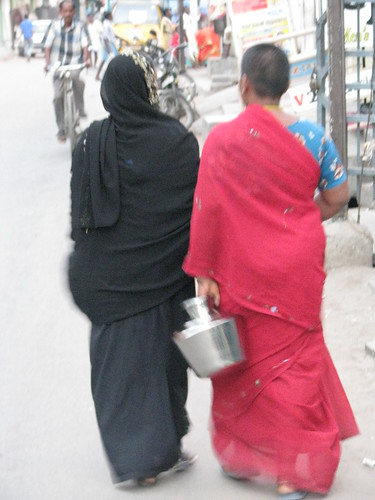
Hindu Muslim

WHAT A SIGHT...in a place where beliefs/religions live harmoniously together...here is a Hindu woman and Muslim woman...laughing and chatting together


We're never going to resolve the Hindu Muslim conflicts in India without understanding more about each other and where are these avenues for understanding? I don't know of any.

=======
Photo by audi_jo, clickthrough

Tuesday, March 17, 2009

Beautiful Minds

I don't know how many of you'll know about TED , http://www.ted.com.  Its a unique event that happens every year in California where a bunch of smart people are invited to present their ideas ; "Ideas Worth Spreading" its called. Anyway its become a kind of cultish thing. The talks themselves are generally prettty good, though on a wide range of topics so that they might not interest everyone. They archive the talks at their site, releasing a new one every day. Nandan Nilekani spoke there this year.
 
http://www.ted.com/index.php/themes/top_10_tedtalks.html  might be a good beginning point, Top 10 talks. I haven't seen all of them yet, but here's one that's really cool:
 
 
I and Priya were at a similiar event in Bangalore called "Beautiful Minds" this weekend . The list of speakers is up here (http://www.beautifulminds.co.in/who.htm) . It was pretty good ! Not a lot of better ways to spend a Saturday than listen to a bunch of smart committed people talking about their passions. I think it would be excellent if a lot more of these happened in India, since life tends to be pretty humdrum otherwise (!) and offer relatively little intellectual stimulation or exposure to new ideas. Huge bonus was the location, Our Native Village, an eco-resort. They had *great* organic food for lunch. And it was all free.


Sunday, February 22, 2009

On movies

On movies:
 Saw "Slumdog Millionaire" recently and rewatching bits of "Motorcycle Diaries" on TV right now. I'm again struck by a certain gap between movies -- there are a few that are excellently made and feel truthful, and then there are some more that are really rich and complex and have a depth to them that the other category does not have. Slumdog Millionaire falls into the first category for me, and therefore does not seem totally Oscar-worthy, though it might still be the best film this year. What are the deeper films ? Brokeback Mountain perhaps. Motorcycle Diaries also does not have that much depth I feel; though if took on the challenge of Che's later life it would probably get that depth. Woody Allen's movies are excellent examples of good movies of the shallower category, though at his best (Crimes and Misdemeanours, Annie Hall) they scrape into the Great category. Apollo 13 and Titanic and Usual Suspects took relatively mundane topics and elevated them to Great (or almost). The Matrix trilogy was completely inconsistent in quality but kind-of scrambled up there.
 What movies do you think are great ?
===
 I'm twittering actively -- visit me there ! http://www.twitter.com/ahminotep . Twitter is remarkable in its potential to propagate information instantaneously.
===
 Its occured to me subconsciously several times, and suddenly struck me forcefully -- its striking how close Riley's (the obnoxious kid on "Boondocks", might have got the name wrong) character is to Sukesh Patro's. Right now there's a thread going on about how the kid insists on being as slothful as humanly possible in front of the TV. Apologies to those to whom all this means nothing.
 

Sunday, February 15, 2009

Financial crisis

I know painfully little about the financial crisis but some of my recent reading has been about how to handle the fact that the banks got us in trouble in the first place so is a punishment appropriate. Earlier I vaguely bought into the "Economist" magazine kind of view, which was that its huge mess and the banks were responsible but now we have to get out of it, and lets be realistic, we need to work with them on it so we can't get all medieval on their asses and so on. But read an interesting transcript of an interview recently :
where a high profile guy is saying that we should go to the extreme and 'break the power' of the bankers. Felt like he has a point. I was fantasizing about what could be done to punish them. Perhaps we (well not 'we', but 'they' as in the American govt. or American people) could say that all the banks don't give any salary to their first line officials at all for x years, or until they pay back the govt money, and also take away all their 2008 bonuses. The fundamental case is very strong -- when you've wreaked havoc on the world economy and so many people are out of a job because of you, its completely reasonable that you should be quite stringently penalized financially, especially as you've made enough money over your banking career to never have to ever contemplate being close to a median national income in your life ...
 
Opinions ?

Tuesday, November 04, 2008


PIX: Unrelated, from the Sun Temple at Konarak


A bunch of new stuff from a short visit to Chennai -- will try to post things over the next few days.

First off, thoughts triggered by the railway journey:

1.) Why is it that land and sea based transport is nowhere as fast as air transport. There must be some physics principle that is at the the heart of this question. Can you identify it ?

2.) In the earlier days of rail transport there used to be pieces of rail track, 30 or 40 feet long, and bolted together (it used to be cited in physics text books as an example of expansion and contraction, that there had to be a small space here to accomadate the expansion). Yesterday in some stretches I couldn't see these boltings and the track looked to be a seamless piece. Probably there was some small welding that was not visible from the running train. I remember reading about this sometime earlier.

3.) Poll: How many of you have taken the time to figure out the mechanism that allows tracks to join up and separate. I mean the junction kind of things, where two rail tracks intersect and go on, and an incoming train on one of the tracks can switch to the other one. I confess that I only did this recently. Its quite a clever system. I wish things like this were explored early on in school, it would make the education more practical and relevant.